The Evolution of Remote Work
From Niche Practice to Mainstream Model
Remote work isn't a pandemic invention. By the 2010s, it was already gaining ground in sectors like IT, consulting, and media, as organizations began recognizing the benefits of reduced overheads and access to talent pools beyond their home cities and countries. It was a competitive advantage for early adopters — not yet the default.
The 2020 Inflection Point
2020 changed the timeline entirely. Lockdowns forced companies worldwide to implement work-from-home policies almost overnight, and remote work went from "emerging trend" to "operational necessity" in a matter of weeks.
The shift stuck. Gallup's 2021 workforce study found that among employees already working remotely — whether hybrid or fully remote — 91% wanted to continue working that way going forward, split between a hybrid preference (54%) and staying fully remote (37%). That number didn't fade as the pandemic did; it solidified remote and hybrid work as a long-term model, reshaping what employees now expect from where and how they work.
This is the backdrop every employee engagement platform has to design for: a workforce that isn't going back to how things were, and a leadership layer that has to build culture without relying on being in the same room.
Why Remote Team Building Matters
The Business Cost of Workplace Loneliness
Workplace loneliness isn't a soft HR concern — it's a quantified, board-level problem. Cigna's Loneliness Index found that absenteeism and productivity losses tied to preventable loneliness cost employers more than $154 billion annually, a figure serious enough to be cited in the U.S. Surgeon General's 2023 advisory on the public health impact of disconnection.
Loneliness Hits Younger, Remote Employees Hardest
The data gets more specific — and more urgent — when you break it down by generation and work arrangement. Gallup's 2025 workforce research found that Gen Z employees working fully remote report feeling lonely "a lot of the day yesterday" at nearly three times the rate of baby boomers in the same remote arrangement (27% vs. 10%). This is the demographic organizations are hiring the most right now, and the one least equipped — structurally, not personally — to build workplace connection without deliberate intervention.
This is precisely the gap between hybrid team activities and remote team building initiatives that exist to close: manufacturing the moments of connection that used to happen by accident, near a coffee machine or in a hallway.
The Retention Risk of Poor Remote Onboarding
The consequences show up fastest at the point employees are most disconnected: their first few months. Paychex's research onboarding found that remote employees are 117% more likely than on-site employees to plan to leave their employers soon — a gap driven largely by weaker early connection and support, not job dissatisfaction itself.
Put together, these three data points tell a consistent story: disconnected employees are expensive, disconnection hits younger and remote employees hardest, and the earliest days of the employee lifecycle are where the damage compounds fastest.
The Problem Existing Tools in 2025 Couldn't Solve
What Was Killing Team Engagement?
When Adappt pitched the idea of GameJamm, the starting question wasn't "what engagement feature should we build?" It was more fundamental: what was actually killing team engagement efforts inside organizations?
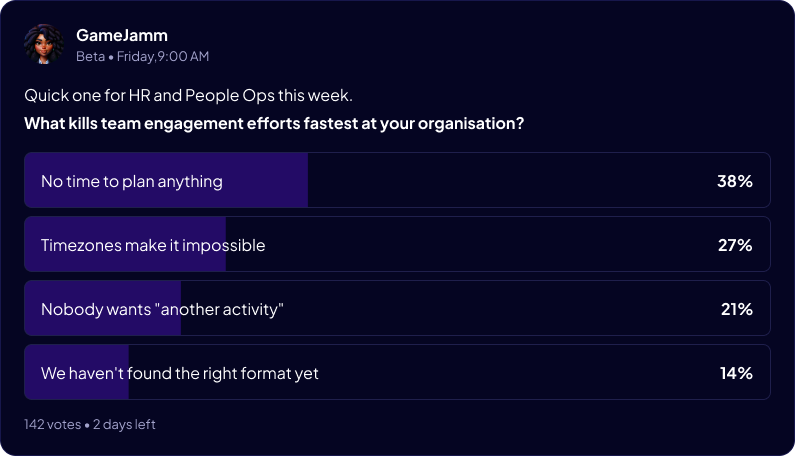
The answers pointed in several directions at once — disconnected remote teams, cross-timezone coordination fatigue, onboarding that failed to build early belonging, and generational gaps in how connection gets built at work.
One Platform, Every Pain Point
Here's what made this a genuine gap rather than a crowded market: every one of those answers had historically been treated as a separate problem, solved (if at all) by a separate tool — one platform for onboarding, another for recognition, another for virtual socials, none of them talking to each other or built specifically for how distributed teams actually work.
GameJamm was built on a different premise: these aren't separate problems. They're symptoms of the same underlying gap — the absence of a genuinely purpose-built platform designed around how remote and hybrid teams actually connect, not a patchwork of HR engagement tools repurposed from in-office playbooks.
That's the problem GameJamm exists to solve.